Bottega Veneta Deepdive
We explore Kering's most premium brand

Please see disclaimer at bottom of writeup
Introduction
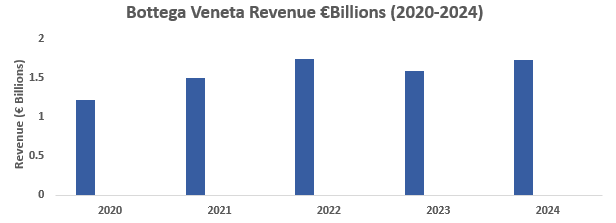
Bottega Veneta experienced a strong revival from 2020 onward, distinguishing itself within Kering’s luxury portfolio. In 2020, despite the pandemic, Bottega Veneta’s revenue grew by nearly 5% to €1.21 billion, a remarkable achievement as many peers saw declines. This growth was fueled by robust demand in Asia (especially China) and a surge in online sales, which offset lockdown impacts in Western markets. By 2021, the brand surpassed €1.5 billion in revenue – a 25% comparable increase over 2020 and 32% above 2019 levels All product categories rebounded sharply, and Bottega Veneta significantly outpaced many peers in recovering from the pandemic slump, reinforcing its rising status in the luxury sector.
In 2022, Bottega Veneta achieved a record year with revenue reaching €1.7 billion (up 16% reported). This growth placed it firmly as Kering’s third largest house after Gucci and Saint Laurent. Notably, Bottega’s 2022 growth was driven entirely by its directly operated retail stores (+15% comparable), while wholesale remained flat. This underscores a strategic push toward exclusive distribution, contrasting with some peers who still relied on third-party channels. By comparison, Gucci’s 2022 growth was a modest +1% (comp.) and Saint Laurent’s was +23%, highlighting Bottega’s solid momentum among Kering brands.
However, the macro challenges of 2023 hit the luxury sector broadly, and Bottega Veneta saw a moderation in performance. Full-year 2023 revenue dipped to €1.6 billion, a 5% reported decline (–2% comparable). This slight pullback was largely deliberate: Bottega significantly scaled back wholesale (–24% comparable in 2023) to enhance brand exclusivity. Encouragingly, sales in the brand’s own stores grew 4% on a comparable basis in 2023, indicating resilient consumer demand even as external headwinds (such as slower U.S. spending and China’s uneven recovery) persisted. In fact, by late 2023 the brand was regaining traction: fourth-quarter 2023 retail sales rose 5% comp, buoyed by North America and a rebound in China. This resilience continued into 2024. Despite a difficult luxury market, Bottega Veneta posted a positive performance for 2024 with revenue back at €1.7 billion (up 6% comparable). The brand’s growth in 2024 was again led by its own boutiques (+10% comp), while wholesale was pruned by a further 15% to maintain its prestige positioning. Notably, Bottega’s fourth-quarter 2024 sales jumped 12% comp, driven by outstanding results in North America and Western Europe. This trend underscores Bottega Veneta’s outperformance relative to peers: for context, Gucci’s 2024 revenue fell 21% comp amid a brand reset, whereas Bottega managed mid-single-digit growth, solidifying its position as a growth engine for Kering.
Positioning versus peers, Bottega Veneta has carved out a niche of “quiet luxury” and timeless appeal. It remains smaller in scale than mega-brands like Gucci (~€7.7B revenue in 2024) or Louis Vuitton, but competes effectively by targeting high-end clients seeking understated exclusivity. Bottega’s revenue is comparable to other rising luxury houses (for example, it is in the same league as Loewe or Celine by size), yet its growth trajectory from 2020 to 2022 outshone many. In summary, over 2020–2024 Bottega Veneta has strengthened its brand equity and top-line relative to peers, turning a once-sleepy label into one of the sector’s most watched companies.